Lost Anchors and the Men who found them.

Have you ever wondered how those Cape Cod status symbols – the large iron anchors on front lawns – became available? In most cases, their original owners lost them when their sailing vessels had to leave their anchorage in a hurry. Finding anchors left behind was one of the occupations of Cape Cod watermen up until sailing vessels were no longer a popular means of carrying cargo and people.
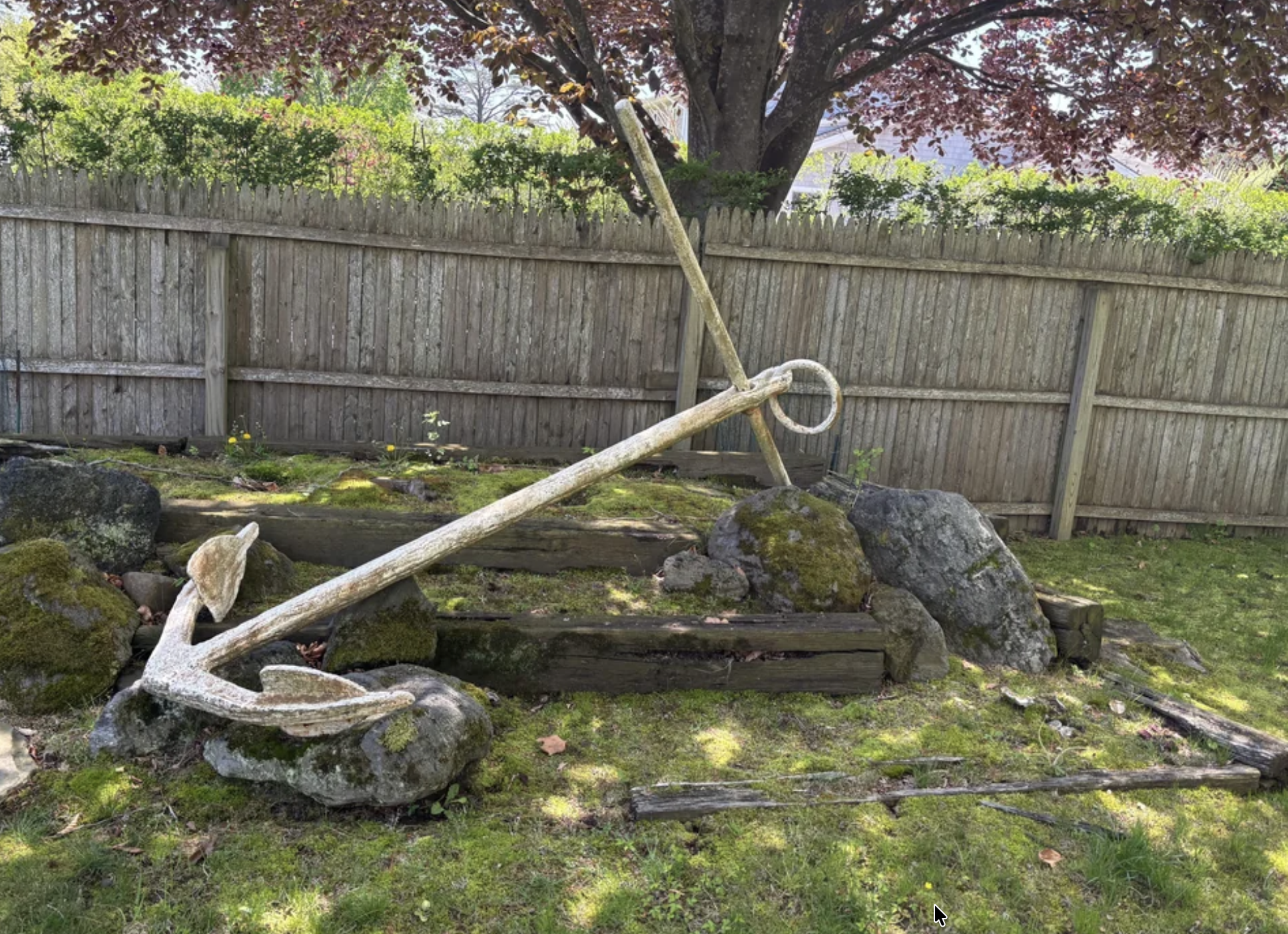
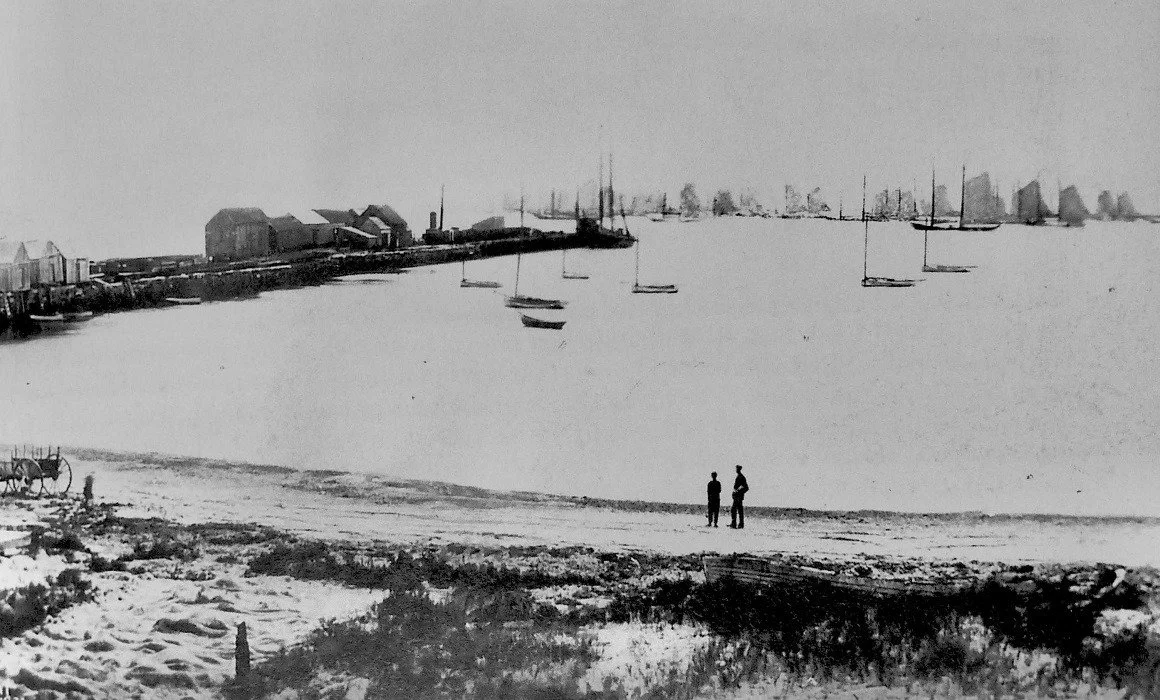
The business was known as anchor dragging proved quite lucrative wherever boats were anchored. Several anchorages were used frequently, including off of Bass River, all along the south coast of the Cape, and in the harbors where wharves were accessible only when the tide was in. The south coast of Cape Cod was a favorite haunt of the anchor draggers, as ships coming from New York and other more southerly points would have to wait for a favorable wind before they could round Monomoy and head for Boston. Anchors have been found in Barnstable harbor and along the bay coast as well, testimony to the vessels and men who tried to save themselves from being forced aground by waves and weather.

The Register reported a gathering of vessels on the southside in 1903 – “Feb 14 – On the 9th inst. A pretty sight was witnessed from Yelverton Farm on South Sea Avenue, which has a commanding view of Vineyard Sound. During the high westerly wind then prevailing could be seen at anchor to the west of Handkerchief shoal one tug boat, seven barges, ten three-masted schooners, eight two-masted schooners, eleven four-masted schooners, one five-masted, one bark, one steamer, and farther out in the distance the new seven master Thomas W. Lawson. Farther on to the westward near Hyannis were visible fifteen others. All were probably coal-laden and bound to northern ports.”
There were no weather forecasters with computer charts back then, and if a storm or contrary wind arose suddenly, the captain would have to “Slip his lines” and leave his anchor behind, or risk being blown aground. Using a windlass to bring in an anchor was a time-consuming task, and on occasion there just wasn’t time. 

Richard Henry Dana, in his epic Two Years Before the Mast, wrote of frequently slipping lines due to contrary winds. The number of times that he wrote of his vessel doing so speaks to the frequency with which anchors were left behind.

When this happened, captains or their mates took rough calculations as to where they had left their anchor and then tried to hire local watermen to retrieve it. It must have been a negotiation all in favor of the waterman, for if the price weren’t high enough, the waterman knew the location of the anchor and could retrieve and sell it later.
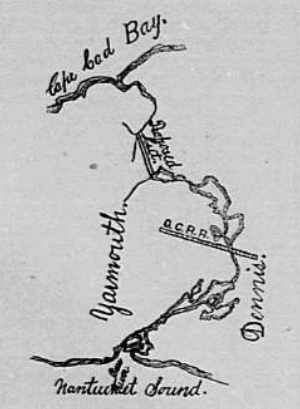
The proposed Bass River canal, 1887.

The problem of waiting for a favorable wind was one reason why there was interest in a ship canal across various parts of the Cape. The preferred location for a canal depended upon the kind of vessel that would use it. For sailing vessels, Buzzards Bay was very difficult to sail out of, because the vessel had to sail into the prevailing wind. A proposed Bass River canal provided easier entrance and egress for sailing vessels, but wasn’t the most convenient route between Boston and New York.

Florence Baker, in her outstanding maritime history of the Bass River area called Yesterday’s Tide, described in detail how anchors were retrieved. Small schooners were used, usually not much over 50 feet in length. Two of the more famous anchor dragging schooners of Yarmouth were the Floretta C., captained by Isaiah Covil, and the Isabel Fuller, captained by William B. Fuller. The two men were friends who often worked in tandem.
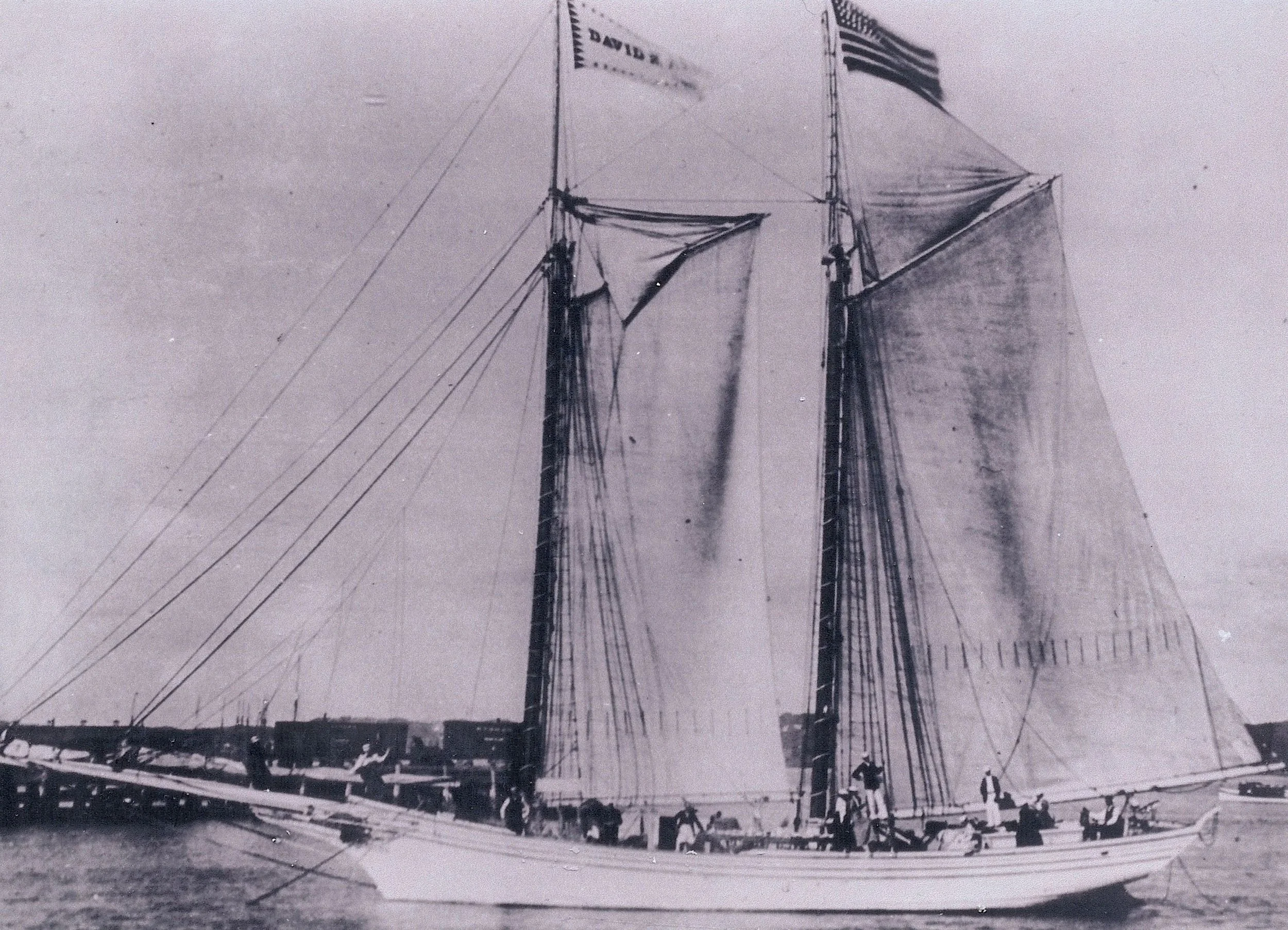
The schooner David K. Akin, also based in Bass River, was similar in shape and size to the Floretta C. and the Isabel Fuller.

The two vessels worked together. They utilized a hawser (rope) that was usually an inch or more in diameter, soaked in seawater, and attached to the two vessels. It was more than 2000 feet in length and weighed down near each schooner so that most of the line would drag along the bottom. The two vessels would then sweep through the suspected area slowly, hoping that the submerged line would catch on one of the points of the anchor, called a fluke or palm. Then, the two vessels brought the lines together making sure the anchor remained snagged, and slipped a lead ring around the two lines which would slide down the lines and secure the lines to the anchor. This lead ring was called a messenger.

Then, if the anchor wasn’t too large, the lines were attached to a windlass in the bow of one of the vessels and the anchor was literally cranked in. If it were too large to get into the schooner, it was brought near the surface and tied to the side of the schooner. 

Large anchors, or those buried deeply in the sand, required the help of the tides to retrieve them. With both vessels lashed together, the lines were brought up between them and attached to both of the vessels. The lines made as taut as possible at the lowest tide. When the tide came in, the vessels floated higher from the ocean floor and the anchor was lifted out of the sand. The largest anchor retrieved by these captains was one weighing more than 7,800 pounds, almost four tons.

Sometimes the water was clear enough so that crewmen in the rigging could look down into the relatively shallow water and spot what looked to be an anchor. In some respects, finding an anchor was not unlike “sight fishing” for stripers on the sandy flats off of Monomoy today. Only the prey was different!

An anchor dragger working alone might utilize dragging irons with hooks to try and snare the chain attached to the anchor, because the chain could be as valuable as the anchor itself.

As the weather turned worse as winter approached, the anchor draggers often went south, hunting near Sandy Hook, NJ, and south to the Delaware and Chesapeake Bays. During some cold winters, they went as far south as Charleston, SC and Savannah, GA. 
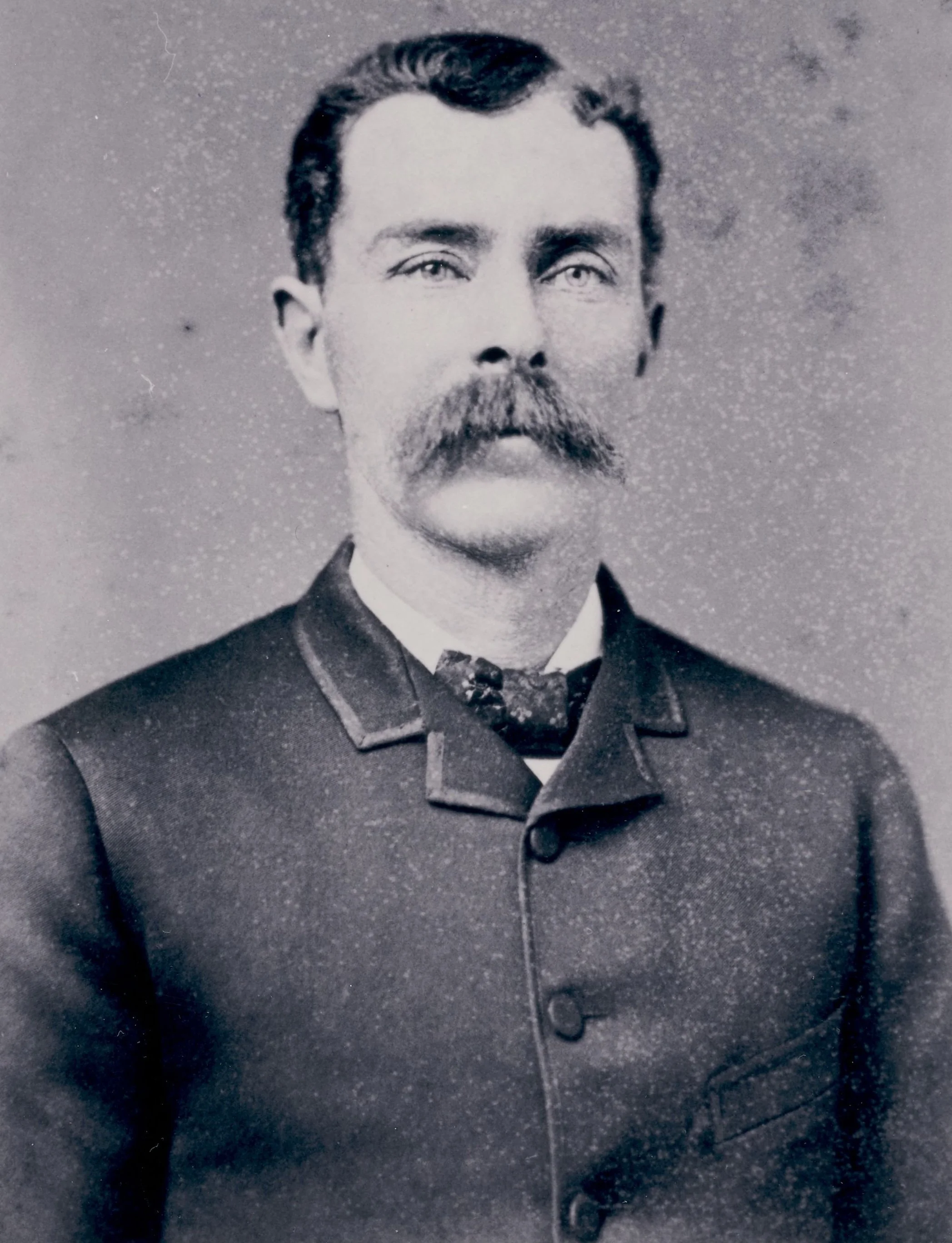
Capt. William Hurst was an anchor dragger who lived in Bass River.

Florence Baker wrote that during one six month period of anchor dragging, William Fuller caught 99 anchors, varying in size from 25 pounds to 7800 pounds. The most brought in during one day’s work was seven. 

Captain Fuller was an anchor dragger for more than 40 years, making him the most veteran of these watermen. Other South Yarmouth men who captained anchor draggers included Isaiah Covil, William Chase, William Hurst, Vinnie Crowell, Wilfred Fuller, and captains Warren and Loring.

Today, anchor dragging is just a fond memory. It harkens back to the days when Cape Cod was a place where sailing vessels visited or anchored, waiting for better weather to continue. The most visible remembrances of those good old days are the anchors that now adorn lawns and driveway entrances.

Researched and written by Jack Braginton-Smith and Duncan Oliver
Thomas Greenough : Yarmouth native

The names of Yarmouth’s earliest settlers are familiar to most - Thacher, Hallet, Howes, and others - but there is another that is equally remarkable in Yarmouth’s history.  The name of Thomas Greenough dots many historical accounts, almost as a side note, a reminder of a people who lived here long before the European settlers arrived, who were here to interact and negotiate with the arriving settlers, and whose descendants remained in Yarmouth to contribute to its growth, economy, and way of life. Greenough’s ancestry is represented in equally notable Yarmouth citizen names such as Cobb, Cash, Taylor, Ellis, Nickerson, and others. Thomas Greenough certainly was not the first indigenous person to be noted in Yarmouth records, and he was not the last. Much is still unknown about Thomas, his family before him, and other such citizens who lived and struggled along side him.  There are, however, facts that can be pieced together to give a good picture of his life.

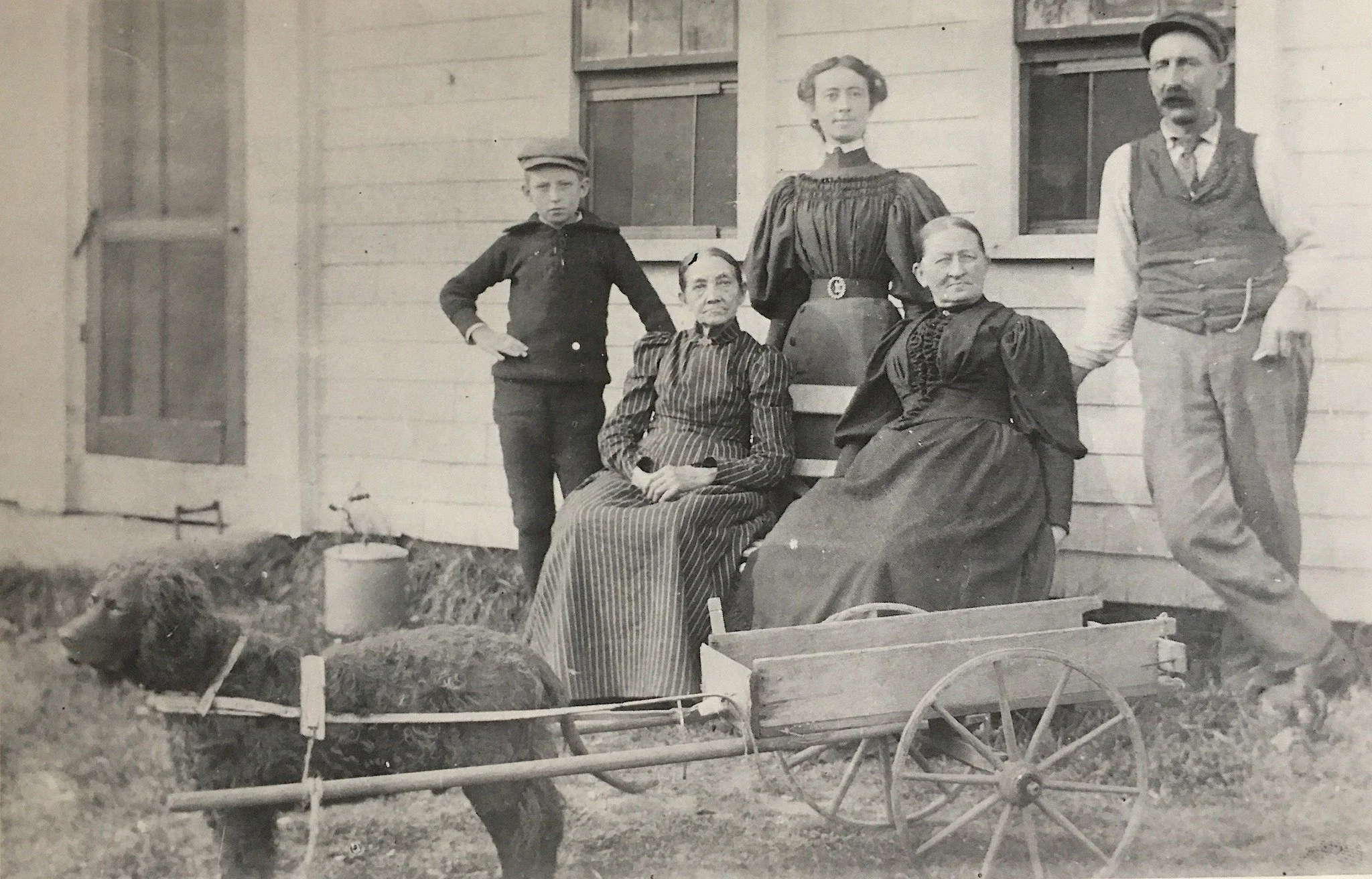
The Cook family of Yarmouth Port are descendants of Thomas Greenough.
L to R Walter P. Cook, Susannah (Greenough) Cook, Cora Cook, Abbie Cook and Thomas Greenough Cook. (HSOY collection)

Thomas Greenough was born approximately 1746. His parentage is unknown, yet several Yarmouth accounts call him the son of a Native American mother and a white father.  

A list of participants in a society at Potenumicut compiled in 1765 by Reverend Ezra Stiles includes Thomas Greenough of Yarmouth as well as others including Nawhut (Nauhaught) and members of the prominent Ralph family. Potenumicut was the location of an Indian meeting house where members from groups east of Mashpee gathered for worship. This congregation included indigenous men, women and children from Harwich, Eastham and Yarmouth. (Massachusetts Historical Society, miscellaneous bound manuscripts.) It is at meetinghouses like this one that Thomas Greenough was educated and preached to by ministers and teachers both indigenous and white.

Sally Greenough, granddaughter of Thomas and Jane.

Intentions of marriage between Thomas Greenough and Jane Freeman, both of Yarmouth, were recorded 23 October 1768. They lived in a section of South Yarmouth called “Indian Town.” The history of the reservation land has been researched and documented extensively by HSOY President Bob Kelley and can be reviewed here. Jane Freeman’s origins are unknown.  It is possible that she was one of the many “servant girls” identified in the probated wills, and other records, of the numerous wealthier citizens across Cape Cod. Thomas and Jane had six children : Susannah, born 1770; Phebe, born 1772; Thomas, born 1781; John, born 1784; Jinne/Jane, born 1787; and Salle/Sally, born 1789. Aside from being identified in records for the births of her children, Jane was a shadowy figure until February 1803 when she was baptized in the Yarmouth Congregational Church. Her death on 3 March 1826 is notable in that at the time of her burial, due to complaints by one or more citizens of Yarmouth, the Town ordered that “Thomas Greenough and other people of colour be requested to remove their dead from the place they are now deposited & bury them in the southeast corner of the burying yard (Ancient Cemetery) as is to be laid out by the Selectmen for that purpose.” Additionally, it was ordered that several constables of Yarmouth be “requested to call on Thomas Greenough and others, and request them to remove their dead to the southeast corner.”

Jane Greenough’s death noted in the First Congregational Church of Yarmouth’s records, 1826

In the mid 1700s smallpox ravaged the area, and on 12 November 1778 the Yarmouth Tribe requested funds to pay for expenses incurred for their care during the epidemic. The Town “having no money” voted to pay for this care by dividing up, selling, or leasing the 160 acres of reservation land in South Yarmouth in order to reimburse the town treasury. The Town did reserve a piece for Thomas Greenough (see map) on which to live which has been identified as on the northern part of the former reservation by Long Pond.  

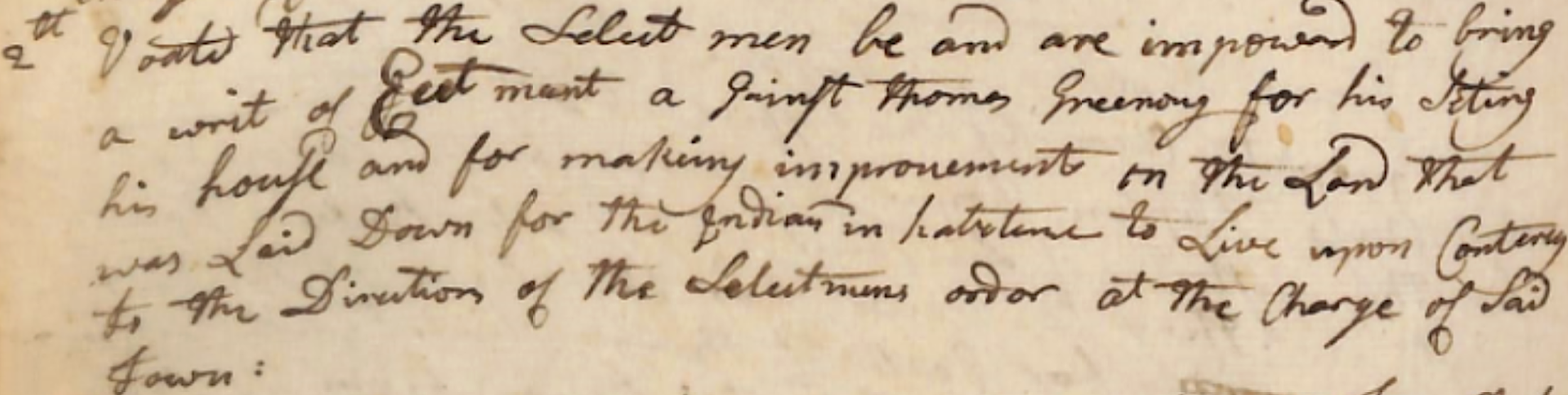
Subsequently in 1779, a dispute arose between Greenough and the Town of Yarmouth which resulted in a writ of ejectment against him for “setting his house and for making improvements on the land that was laid down for the Indian inhabitants to live upon contrary to the direction of the Selectmen’s order at the charge of said Town.”

In 1785, Isaac Taylor leased to Thomas Greenough seven acres of former reservation land along Bass River. Greenough, called a fisherman and then laborer, leased this land in two transactions, dated 1790 and 1797, to David Killey. Again HSOY President Bob Kelly has documented these transactions extensively. Thomas Greenough signed his name on both of these leases, and one lease appears to have been written entirely in his hand. Greenough ultimately moved to the north side of Yarmouth, perhaps in the area of Dennis and Greenough ponds, though more research on the location is needed.

Daniel Wing, in his Description of the Farris Windmill in South Yarmouth, writes that he had been informed that the initials T.G. and the date 1782 were inscribed in black paint on the inner wall of the mill, and that they stood for Thomas Greenough, an indigenous person who had taken part in moving the mill to the area at that time. Several other accounts also note Greenough’s initials in the mill, including The Celebration of the Two Hundred and Fiftieth Anniversary of the Founding of Old Yarmouth written in 1889.  These initials and dates are clearly visible in a photograph of the mill now located at the Henry Ford Museum in Michigan.

In 1820 Greenough and others, calling themselves true heirs to the land, filed a petition with the Governor of Massachusetts requesting the return of their land in Yarmouth (Senate Unpassed Legislation 1820, Petition No. 6568; Unpassed Legislation Relating to Indian Affairs, SC1 Series 592X, Massachusetts Archives, Dorchester, Ma.). Their petition describes the hardship endured by not being allowed access to natural use of land for such things as broom and firewood. They claimed that their land was unavailable to them to use in a way that had been their ancestral tradition. These indigenous petitioners of Yarmouth note that the disputed land now held twenty thousand dollars worth of salt works and mechanics, and many houses, yet they had none on which their own children could settle. The petition was ultimately withdrawn, and while over time most of these individuals moved to other areas, several families remained in Yarmouth.  Thomas Greenough, aged 90, died at the almshouse on 8 January 1837.

Click to enlarge

“Mr. Greenough was a curious and in many respects, a wonderful man. We doubt if many, or even any, of our citizens laboring under the same disadvantages would have displayed more wisdom and good sense than he evinced on many occasions. Endowed with an uncommon share of penetration and capable of a just appreciation of rights, he wore, through the last year of his life, the title of ‘Lawyer.’.  He displayed in the management of his business, such tact and skill as few of more pretensions or statesmanship would have blushed to own.” [Excerpt from the obituary of Thomas Greenough in the Yarmouth Register, Yarmouth Port (Mass.), Thursday Evening Edition, January 19 1837, p. 4.]

In 1860, John Milton Earle reported to the Governor on the condition of Native Americans in Massachusetts and listed multiple Yarmouth families identified as having blended into the local economy and fabric of the Town of Yarmouth.

Researched and written by Julie Bear Esposito, a descendant of Thomas Greenough. Top photo of Long Pond, South Yarmouth (HSOY collection)

Franklin Howes Chase, pictured here with his family at their home in Weir Village. Franklin was also a descendant of Thomas Greenough. (HSOY collection)

How HSOY came to own the Yarmouth Port Post Office

Remember last fall when we revealed that HSOY owns the Yarmouth Port Post Office building? Are you curious as to how this came about?  Let us share this interesting story with you.  

In 1958, the year the building was constructed, HSOY was in its infancy and seeking innovative ways to raise funds for restoration of its Greek Revival treasure, the Captain Bangs Hallet House.  Then, seemingly by a stroke of luck, an individual unaffiliated with HSOY came forward and proposed building a post office in a compatible architectural style on land he wanted to lease from the group.  Thus began HSOY’s journey of deriving rental income to further its mission; of fostering the construction of a much-needed new post office; and of focusing on historic preservation and conservation projects on its 50-acre parcel of land. 

The South Yarmouth Pancake Man.

The individual behind building the Yarmouth Port Post Office was John T. Crawford of South Yarmouth.  According to ads that appeared in the Yarmouth Register in 1958, he was the proprietor of Babbitt Rentals, Hyannis, which was a tool and equipment rental business (interestingly enough, in 1961 he and his wife Frances were co-founders of The Pancake Man restaurant in South Yarmouth!).  He also must have been a builder because the U.S. Postal Service awarded him the contract to build the Yarmouth Port Post Office. After the town denied construction at one location, he was forced to identify another site.  It appears that by March of that year, he had contacted HSOY about leasing some land. The minutes of HSOY’s Executive Board meeting, dated March 17, 1958, indicate that “land is to be leased to John T. and Frances Crawford for a term of 10 years at an annual rental of $240, payable in monthly installments of $20…with an option for extension times” and “said property is to be used for a Post Office.”  Ann Maxtone-Graham, co-founder and then-president of HSOY, “…said Mr. Crawford had been very helpful in making the arrangement” and added that “…Royal Barry Wills, well-known Boston architect, would design a colonial style building” (Yarmouth Register, March 14, 1958).

Yarmouth Port Post office, about 1959.

As part of this project, the historically separate Yarmouth and Yarmouth Port post offices merged into one operation.  As highlighted in a May 9, 1958, article in the Yarmouth Register, “[t]he Post Office Department decided to consolidate Yarmouth Port and Yarmouth Post Offices by absorbing the Yarmouth office in the new building…”  

The new post office opened at the beginning of August, with the merging of the two offices having been completed at the end of the month.  The previous Yarmouth Port Post Office was housed in the 19th-century commercial building at 194 Route 6A, which became the offices of the Dennis Yarmouth Register immediately after the post office vacated the building.  The old Yarmouth Post Office was located in a modest gable-front commercial building at 490 Route 6A.  Both buildings survive today; one is a private home, the other is a law office.

By 1969, Mr. Crawford was out of the picture as builder, lessee, and “agent” for the U.S. Postal Service, and HSOY bought the building and leased the land directly to the Postal Service.  In 1978 Theodore Childs, former administrator of Lenox Hill Hospital in New York City and chair of HSOY’s Post Office Committee, negotiated with the Postal Service to arrive at a compatible design for the rear addition to the building (a plaque dedicated to the memory of Theodore Childs hangs in the lobby on the wall opposite the front door). The addition, which doubled the size of the building, was designed by Harold Palmborg of Needham.  

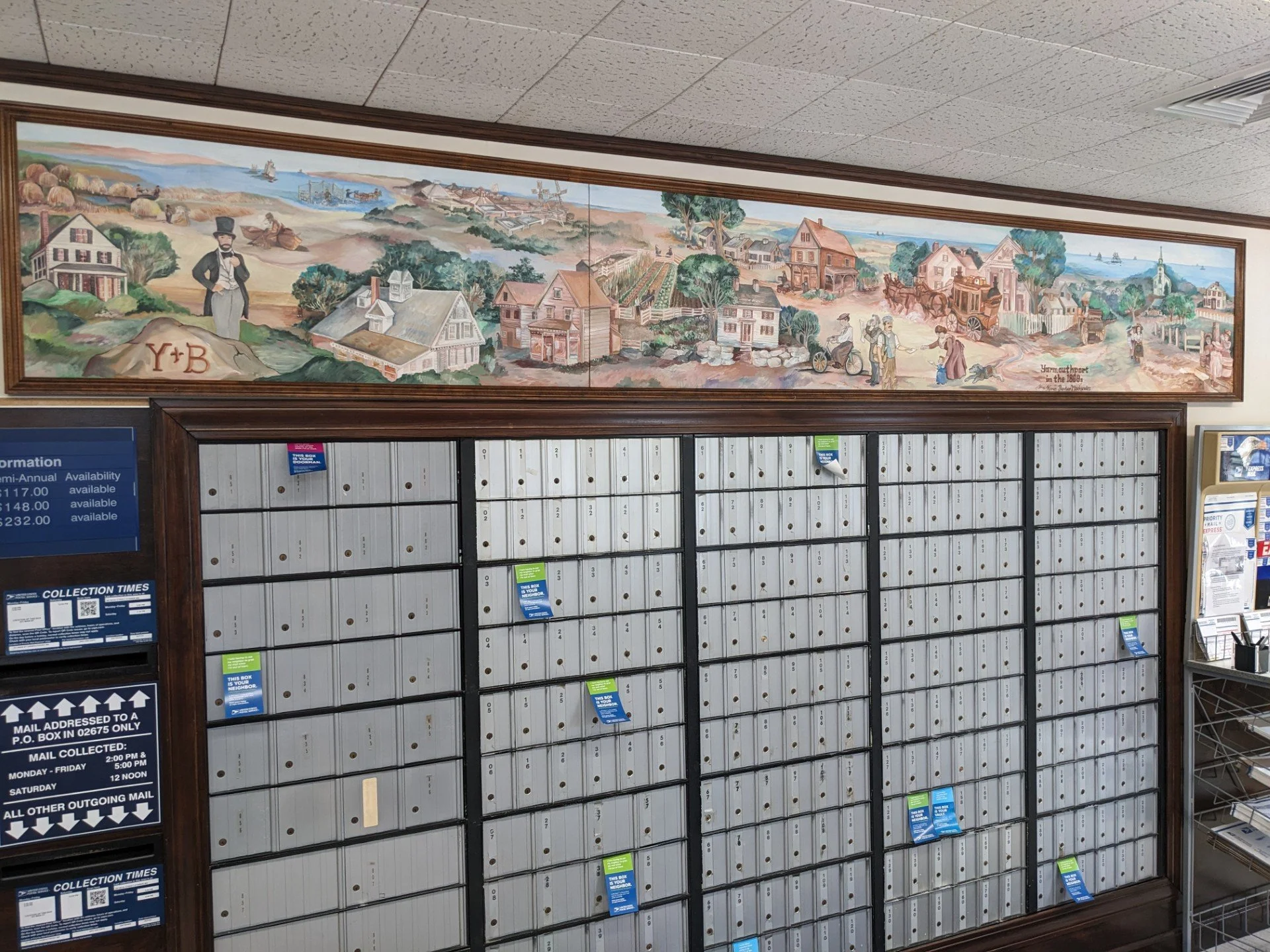
In 1995 Cape artist Karen Dexter Mackiewicz painted a mural entitled, “Yarmouthport in the 1800s,” which hangs above the mailboxes in the lobby opposite the front wall.  This mural was carefully removed and restored by Cape Cod Picture Framing & Restoration/Art Rescue after a car damaged the right side of the front wall and part of the lobby in October 2024. The building reopened to the public on November 26, 2024, after the damaged portion of the front wall had been rebuilt, the front door replaced with an accessible door, and new lobby flooring installed. The restoration of the mural took a little longer, and it was reinstalled in March 2025.

So, there you have it: The connection of the Yarmouth Port Post Office to HSOY and its property is no longer shrouded in mystery.

Researched and written by Gary Sachau